Abstract
Current approaches to group fairness in federated learning assume the existence of predefined and labeled sensitive groups during training. However, due to factors ranging from emerging regulations to dynamics and location-dependency of protected groups, this assumption may be unsuitable in many real-world scenarios. In this work, we propose a new approach to guarantee group fairness that does not rely on any predefined definition of sensitive groups or additional labels. Our objective allows the federation to learn a Pareto efficient global model ensuring worst-case group fairness and it enables, via a single hyper-parameter, trade-offs between fairness and utility, subject only to a group size constraint. This implies that any sufficiently large subset of the population is guaranteed to receive at least a minimum level of utility performance from the model. The proposed objective encompasses existing approaches as special cases, such as empirical risk minimization and subgroup robustness objectives from centralized machine learning. We provide an algorithm to solve this problem in federation that enjoys convergence and excess risk guarantees. Our empirical results indicate that the proposed approach can effectively improve the worst-performing group that may be present without unnecessarily hurting the average performance, exhibits superior or comparable performance to relevant baselines, and achieves a large set of solutions with different fairness-utility trade-offs.
Type
Publication
In International Workshop on Federated Learning: Recent Advances and New Challenges at NeurIPS 2022 (extended version on arXiv, 2024)
We address a fundamental limitation of existing fair federated learning methods: the assumption that sensitive groups are predefined and labelled during training. In many real-world scenarios — due to privacy constraints, evolving regulations, or location-dependent group definitions — this assumption does not hold.
We propose FedSRCVaR, an approach that learns a Pareto efficient global model guaranteeing worst-case group fairness without any predefined group labels. A single hyper-parameter controls the fairness–utility trade-off, subject only to a minimum group size constraint, meaning any sufficiently large subgroup is guaranteed a minimum level of utility. Our algorithm comes with convergence and excess risk guarantees in the convex setting. Experimentally, FedSRCVaR surpasses relevant federated baselines, matches centralized approaches, and recovers existing objectives (including ERM and subgroup robustness) as special cases.

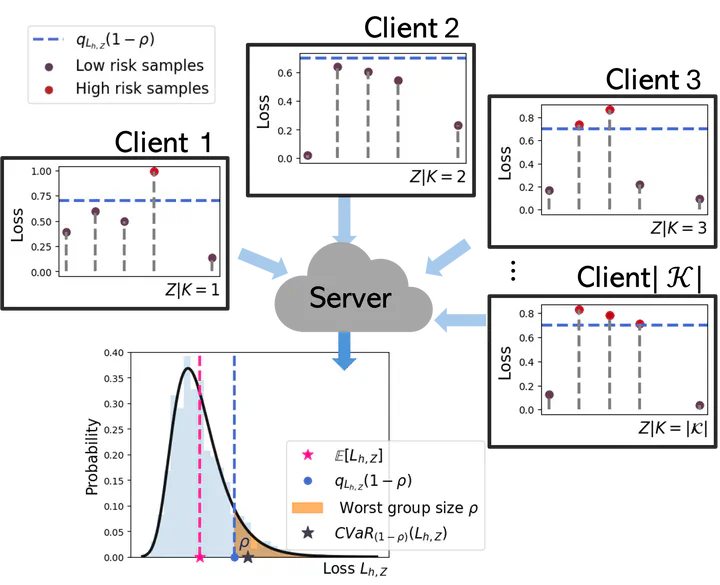 Image credit: paper